Twenty-one pieces sounds like a lot of cookware. And technically, it is a lot of pieces - but that number includes lids, handles, pan protectors, utensils, and accessories alongside the actual pans and pots. Two sets can both say "21-piece" while containing meaningfully different amounts of actual cookware.
With Astercook's 21-piece sets, the headline count is consistent. What changes is the mix: which colors are available, how many cookware bodies are in the set, what the lids look like, whether removable handles are part of the design, and what accessories fill out the count.
None of that is obvious from the product name. This article breaks down what to actually look at when comparing these sets - so the number on the box stops being the whole story.
BrandCookware.shop may earn a commission from qualifying purchases.
Why 21-Piece Sets Need a Closer Look
The appeal of a 21-piece set is understandable. It suggests a complete kitchen setup, and for someone starting from scratch or replacing old cookware all at once, it's an efficient way to buy. But "21-piece" as a category label tells you almost nothing about what the set actually contains.
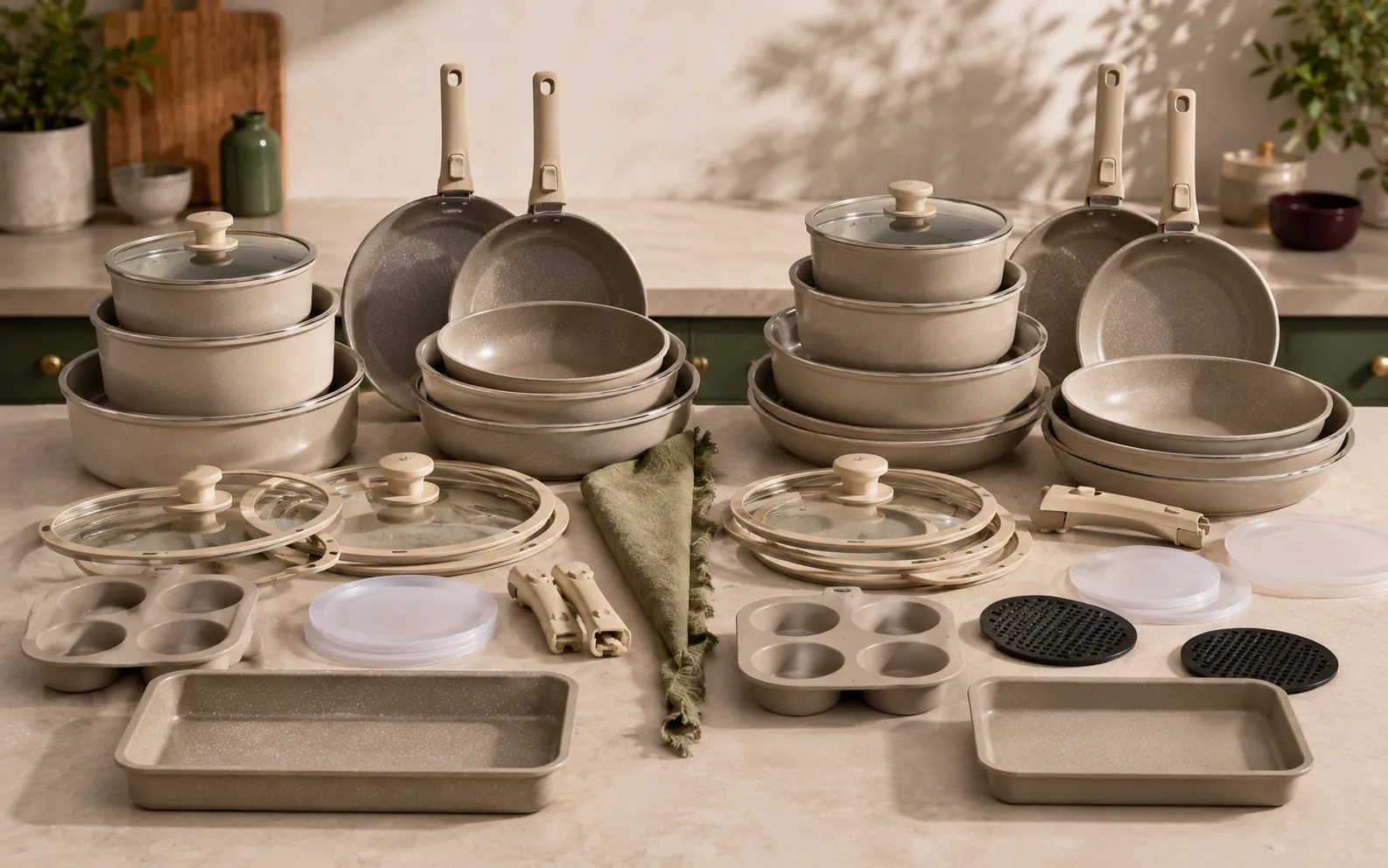
Here's why that matters: cookware sets count lids, handles, pan protectors, and utensils as individual pieces. A set with eight pans and a full lid and utensil complement can hit 21 pieces just as easily as a set with twelve pans and fewer extras. The distribution of pieces across actual cookware versus supporting items is the variable that most buyers don't check until after they've already bought.
With Astercook specifically, the 21-piece label appears across multiple configurations. Some emphasize removable-handle cookware with compact storage in mind. Others are built more like traditional sets with a comprehensive accessories package. The piece count is the same; the set is not.
What May Be Included in the Piece Count
This varies by set, so always verify against the current listing - but Astercook 21-piece sets generally draw their count from some combination of the following:
Cookware bodies: Skillets, saucepans, saute pans, stockpots. These are the core items - what most buyers picture when they hear "21-piece cookware set."
Lids: Each lid is a separate piece in the count. A set with eight pans might include eight lids, which accounts for eight of the twenty-one pieces right there.
Handles: In removable-handle configurations, each detachable handle counts as its own piece. A set with two handles contributes two to the total.
Pan protectors: Felt or fabric pads that sit between stacked pans to prevent scratches. These are useful accessories, but they're not cookware - and they count toward the total.
Utensils or tools: Some Astercook sets include kitchen tools - spatulas, spoons, a turner - as part of the package. Each individual utensil adds to the piece count.
Storage lids or extras: Flat storage lids for refrigerator use, trivets, or other accessories may be included in some configurations.
The takeaway isn't that any of this is wrong - accessories have value. It's that knowing how the count is distributed helps you evaluate whether a set actually delivers the number of cookware pieces you need.
Color and Design Differences
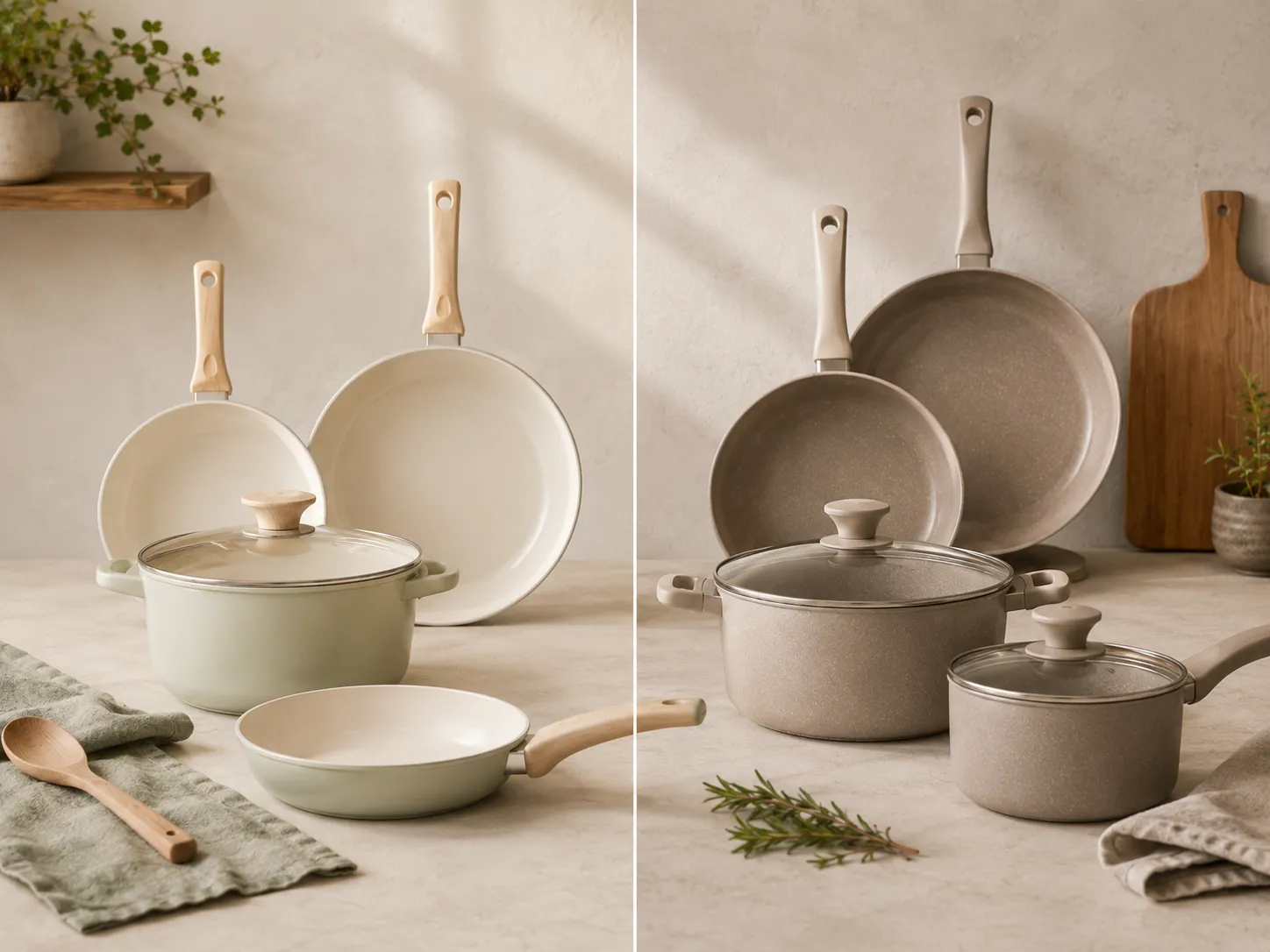
Astercook 21-piece sets are available in multiple color options, and the choice is more personal than practical - the coating and construction work the same way regardless of finish.
What does vary: not every color option is available for every set configuration. A particular finish might appear in one version of the 21-piece set and not another. If color is a priority, check the current listing before assuming your preferred option comes in the set configuration you want.
The finishes Astercook offers tend toward softer, kitchen-friendly palettes rather than industrial looks - but the specific options available at any given time reflect current inventory, and that changes. The listing is the most reliable guide to what's actually in stock.
One practical note: pan color and finish have no meaningful effect on cooking performance for ceramic nonstick. If two set configurations are otherwise equal for your needs, color is a fine tiebreaker - just don't let it be the only thing driving the decision.
Removable Handles and Storage
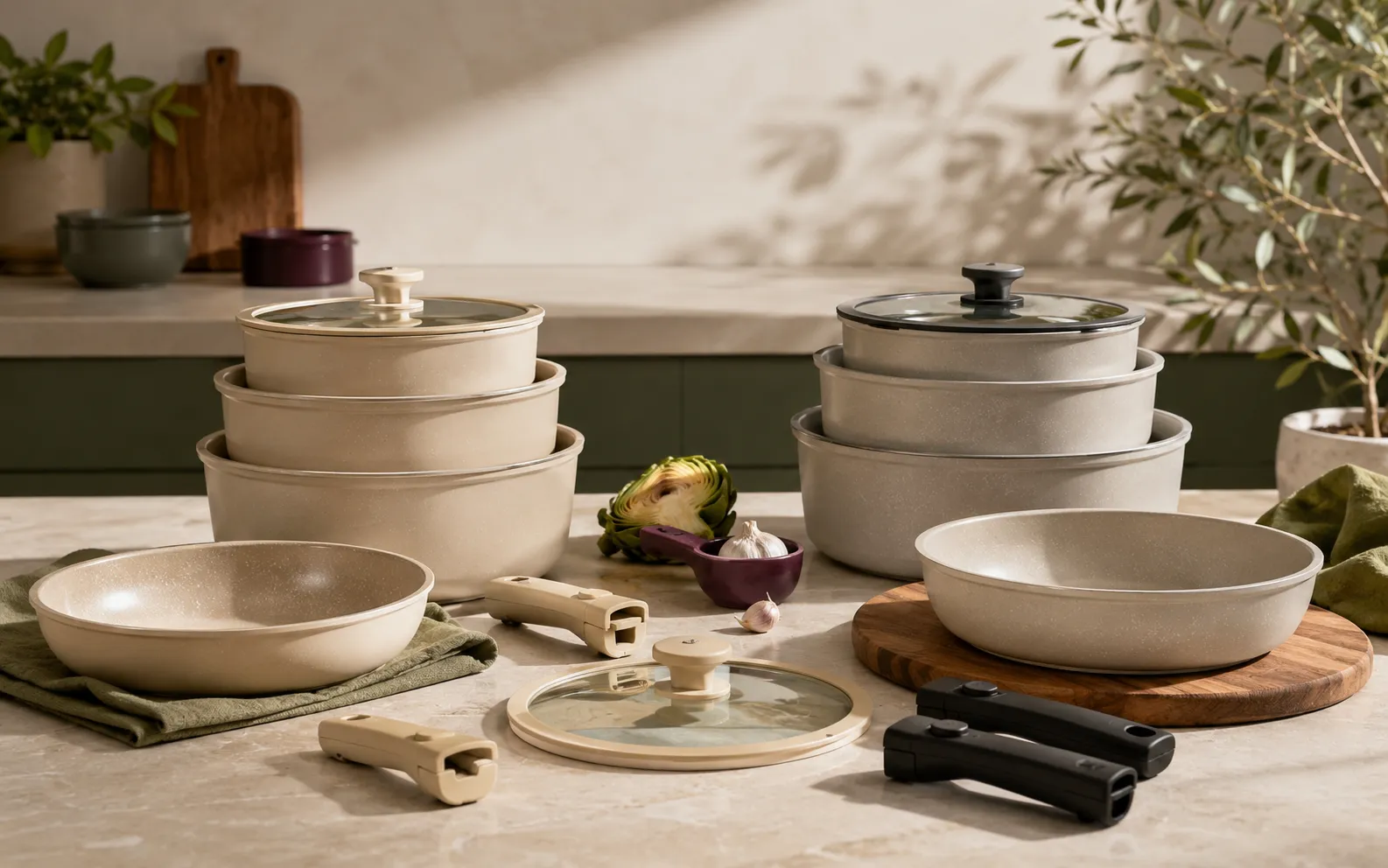
Some Astercook 21-piece sets are built around a removable-handle system; others use traditional fixed handles. This is one of the more significant structural differences between configurations, and it affects storage as much as cooking.
Fixed-handle sets work exactly as you'd expect - handles are permanently attached, pans stack with the help of protectors, and storage follows the same footprint as any traditional cookware set. There's no mechanism to learn and no compatibility to track.
Removable-handle sets let the pans detach from their handles completely, which means they stack flat. Six flat pans take up far less cabinet space than six pans with handles extending in different directions. For small kitchens, this is a real advantage - not a marketing point.
The tradeoff: detachable handles add a connection mechanism that fixed handles don't have. The locking system needs to be secure during cooking, and compatibility can vary across pieces in the same set. Before assuming handles are interchangeable, check the listing for notes on which handle fits which piece.
If storage space is a deciding factor in your purchase, the removable-handle configuration is worth looking at specifically. If storage isn't a constraint, fixed handles are the simpler choice.
Lids, Pan Protectors, and Accessories
These supporting pieces make up a significant share of the 21-piece count in most Astercook sets, and they're worth understanding individually.
Lids: Most lids in Astercook sets are glass, which lets you monitor cooking without lifting and releasing heat. Lids are sized to their matching pan - they're not interchangeable across different diameters. In the piece count, each lid is its own number, so a set with eight pans and eight lids is already at sixteen pieces before anything else is added.
Pan protectors: These are the felt or fabric discs that go between stacked pans. They're genuinely useful for protecting ceramic nonstick surfaces from scratches during storage. The fact that they count as pieces is a marketing convention, not a criticism - they do their job. But they're worth identifying separately so you're not counting them as cookware.
Utensils: If a set includes kitchen tools, those are accessories - not pans. A spatula, a spoon, and a ladle can add three to the piece count without adding any cookware. That's not a problem if you need those tools; it's a problem if you were expecting more pans.
Storage lids: Some configurations include flat storage lids designed to seal pans for refrigerator use. These are separate from cooking lids and add their own count. Useful if fridge storage is part of your plan; not necessary if it isn't.
Check the product listing's breakdown before buying. A well-structured listing will show you exactly what each piece is - not just the total number.
Pan Sizes and Everyday Cooking
Even among sets that include a similar number of actual cookware bodies, the distribution across pan types and sizes can vary - and that affects whether the set actually covers the cooking you do every day.
A set with three skillets of different sizes and one saucepan suits different cooking habits than a set with two skillets and three saucepans. Neither is the wrong configuration - it depends on what you cook most.
Common sizes across Astercook sets include small skillets around 8 inches, mid-size skillets around 9.5 to 10 inches, and larger skillets or saute pans in the 11 to 12-inch range. Saucepans and stockpots vary in capacity. The specific combination depends on the set.
What to consider: If you cook a lot of eggs, fish, and single-serving meals, skillet coverage matters most. If you make soups, grains, pasta, or anything that needs a lid and liquid, you want to make sure saucepans and pots are well-represented. If you entertain or cook for a larger household, the size of the largest pan in the set matters.
The product listing should itemize each piece with its size. If it doesn't, that's worth noting - a well-designed listing makes this easy to find.
How to Compare Astercook Sets Without Relying on Cost
When two sets carry the same piece count and a similar overall look, it's tempting to default to cost as the primary filter. Cost can be a signal, but it's not always the clearest one - especially when configurations vary in ways that aren't immediately visible from the product thumbnail.
A more useful approach:
Count the cookware bodies first. Before looking at anything else, identify how many actual pans and pots are in each set. If one set has nine cookware bodies and another has seven, you know something meaningful about them regardless of cost.
Look at the size distribution. Two sets with the same number of cookware bodies can still be very different if one is skillet-heavy and the other balances skillets and saucepans differently.
Check whether the handle setup matches your kitchen. Removable-handle and fixed-handle sets are different purchases. If cabinet space matters, that question should come before color and accessories.
Assess what the accessories actually are. Utensils, pan protectors, and extra lids have different utility depending on what you already own. If your kitchen is well-stocked on tools, a set that emphasizes accessories may be adding less value than it seems.
Verify the specs that affect compatibility. Induction-safe? Oven-safe to what temperature? Dishwasher-safe? These answers don't change based on piece count and are worth confirming before buying.
What to Check Before Buying
A short list of what's worth verifying in the current listing before choosing a specific Astercook 21-piece set:
- Actual cookware body count - how many pans and pots, not total pieces
- Individual piece sizes - listed by diameter and/or capacity
- Handle type - removable or fixed; if removable, how many handles are included
- Lid type - glass cooking lids, storage lids, or both; which sizes have lids
- Accessories included - utensils, pan protectors, trivets, and what each one is
- Color availability - is your preferred finish offered in this configuration
- Induction compatibility - explicitly confirmed in the listing, not assumed
- Oven-safe temperature - and whether that limit applies equally to handles and pan bodies
- Dishwasher labeling - and the note that hand washing extends ceramic nonstick life regardless
Comparison Checklist
| Comparison Point | Why It Matters | Buyer Note |
|---|---|---|
| Cookware body count vs total piece count | The headline number includes lids, protectors, and accessories - not just pans | Count only the actual pots and pans listed; ignore the total |
| Size breakdown of cookware pieces | A skillet-heavy set and a saucepan-heavy set serve different cooking styles | List out each piece by size before comparing sets |
| Handle type: fixed vs removable | Removable handles allow flat stacking; fixed handles are simpler but take more cabinet space | Match the handle type to your actual storage situation |
| Handle count (removable-handle sets) | One shared handle may limit cooking multiple dishes at once | Check whether one or multiple handles are included |
| Lid coverage | Not every cookware piece necessarily comes with a lid | Verify which pan sizes have matching lids |
| Accessories and utensils | Kitchen tools add to the piece count but aren't cookware | Identify what's a pan and what's an accessory |
| Pan protectors included | Useful for ceramic nonstick storage, but they count as pieces | A set that includes protectors is saving you a separate purchase |
| Color / finish availability | Preferred finishes may not be offered in every configuration | Check current availability before committing to a set |
| Induction compatibility | Not universal across all configurations | Look for explicit induction-safe confirmation in the listing |
| Oven-safe temperature | Handle limits often differ from pan body limits | Check both the pan and handle temperature ratings |
Who Each Type of Set May Suit
There's no single right configuration - but the patterns are fairly consistent.
A removable-handle Astercook 21-piece set may suit buyers who:
- Have limited cabinet storage
- Are setting up a small apartment or studio kitchen
- Want to use pans for refrigerator storage without a separate container
- Cook in an RV or travel regularly with cookware
A fixed-handle Astercook 21-piece set may suit buyers who:
- Have standard cabinet space and no particular storage constraints
- Prefer a traditional cookware setup without a locking mechanism to manage
- Are replacing a full set of cookware and want a comprehensive one-purchase solution
- Want the included accessories and tools as part of a complete kitchen package
Both types suit buyers who:
- Want ceramic nonstick across a full set rather than buying individual pieces
- Are setting up a kitchen from scratch
- Prefer buying from a single brand for consistent care and compatibility
Related Astercook Pages on BrandCookware.shop
The Bottom Line
Astercook 21-piece sets are a practical choice for anyone who wants a complete ceramic nonstick setup in a single purchase. The challenge isn't the quality of the sets - it's that the piece count headline obscures more than it reveals.
Once you look past the number and check what's actually in the box - how many pans, what sizes, what handle setup, what accessories - the sets become much easier to compare. The right one for your kitchen is the one whose actual cookware matches how you cook, and whose storage design matches where you put things.
Take ten minutes with the listing. The information is there.
Keep comparing
FAQ
Does Astercook make more than one version of a 21-piece set?
Yes - the 21-piece label appears across multiple configurations within the Astercook lineup. Differences between versions include color options, whether the set uses removable or fixed handles, the specific pan sizes included, and the accessories that round out the piece count. The current product listings on BrandCookware.shop show which versions are available.
How many actual pans should I expect in a 21-piece set?
That depends on the specific configuration, and the listing should tell you. As a rough guide, if a 21-piece set includes a full lid for every pan, two to three handles (in removable-handle versions), pan protectors, and several utensils, the actual cookware body count might be eight to ten pieces. Some configurations include more pans and fewer accessories; others balance toward a fuller toolkit. Check the itemized list, not the headline number.
Are the handles in removable-handle sets safe during cooking?
Removable-handle systems use a locking mechanism to secure the handle to the pan during use. When properly locked, the handle is stable. The key word is "properly" - it's worth getting familiar with how the lock works on the specific set you buy, and checking reviews for any notes on the mechanism's reliability. A handle that doesn't lock fully is a problem worth knowing about before it's on a hot stove.
Can I use an Astercook 21-piece set on an induction cooktop?
Induction compatibility varies by configuration and isn't universal across the Astercook lineup. If you cook on induction, verify the specific set before purchasing - look for an explicit induction-safe statement in the listing, not just a general brand claim.
Do all pieces in the set need the same care routine?
The pans themselves are ceramic nonstick and share the same basic care habits: low to medium heat, softer utensils, hand washing, and careful storage. Lids, handles, and accessories may have different care or temperature limits. Check the listing for any specific notes on individual pieces, particularly if you plan to use them in the oven.
What's the best way to store an Astercook 21-piece set in a small kitchen?
For removable-handle versions, removing the handles and stacking the pans flat is the most space-efficient approach - this is the core advantage of that design. For fixed-handle sets, pan protectors (often included in the set) between each pan reduce scratching during stacking. A cabinet organizer or pan rack can help both configurations take up less vertical space.