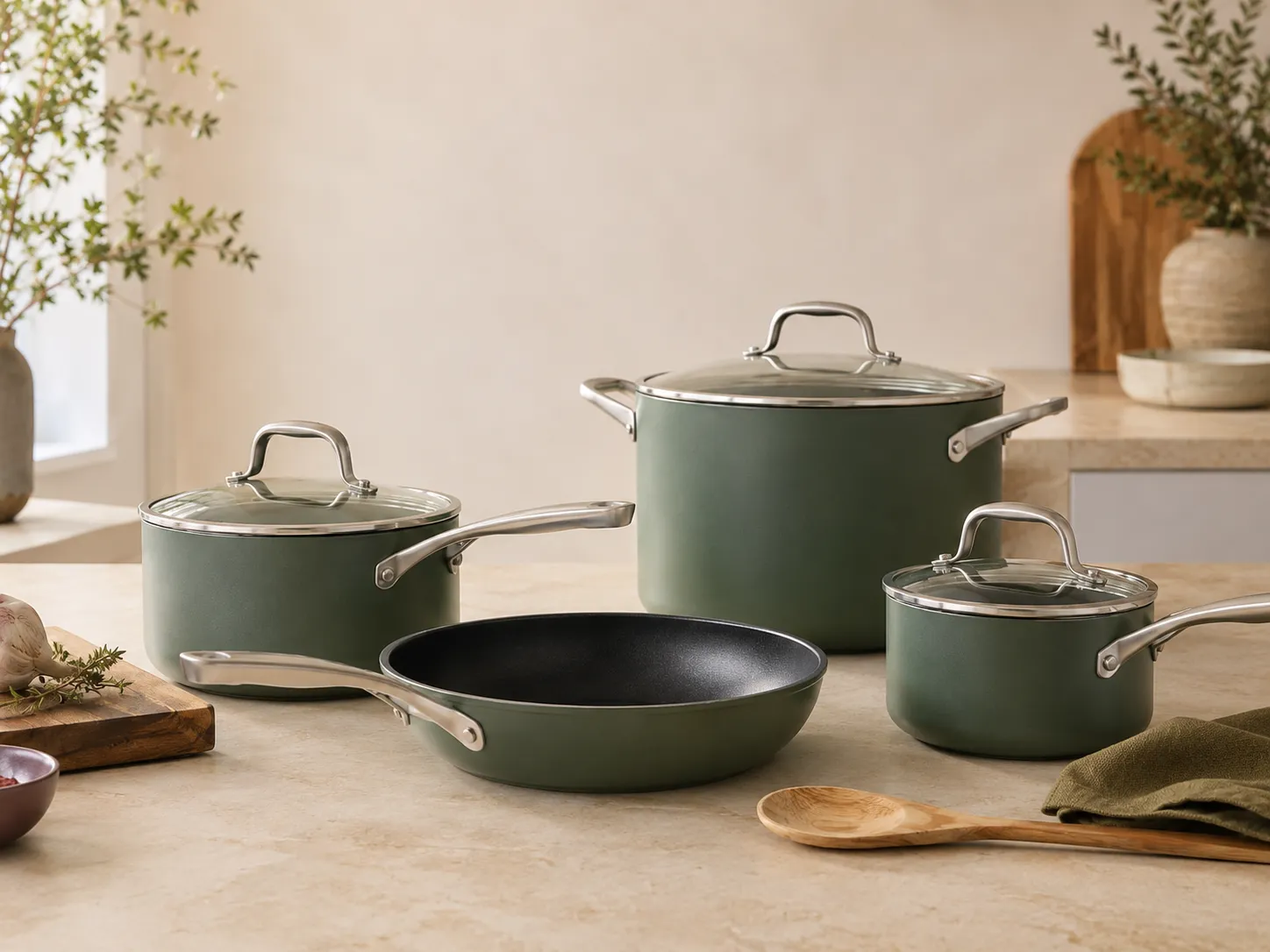
A big cookware set can look useful on the product page and turn into a cabinet problem the day it arrives. The stockpot fits nowhere, the lids slide around, and two pans nest badly because the handles stick out at odd angles.
Small kitchens make cookware choices less forgiving. For an apartment, RV, dorm setup, or narrow galley kitchen, the better set is not always the one with the highest piece count.
The better set is the one with the right cookware bodies, lids that store cleanly, and pans you will actually use more than once.
BrandCookware.shop may earn a commission from qualifying purchases.
Why small kitchens change the buying question
In a full-size kitchen, an extra saucepan or spare skillet may not matter much. In a small kitchen, every duplicate takes space from mixing bowls, food storage, baking sheets, cleaning supplies, or pantry overflow.
Instead of asking how many pieces you get, ask where the set will live, how deep the cabinet is, whether the lids stack, and which pans cover your normal meals.
A compact cookware set has to work twice: once on the stove and once in the cabinet.
Piece count can be misleading
A large cookware set does not usually mean the same number of pots and pans. Lids, utensils, pan protectors, steamer inserts, removable handles, and other accessories often count as pieces.
Some of those items are useful. Some are just extra objects you now need to store.
Before comparing sets, count the cookware bodies first: frying pans, saucepans, saute pans, stockpots, Dutch ovens, or larger covered pots. Then count lids and accessories separately.
What pieces are actually useful
Most small kitchens do not need a crowded cookware lineup. They need a few pieces that earn their shelf space.
A practical small-kitchen set usually starts with a skillet, because it handles eggs, grilled cheese, vegetables, quick proteins, reheating leftovers, and one-pan meals.
A saucepan is next for oatmeal, rice, sauces, small batches of pasta, soup, and reheating. A larger covered pot is useful if you cook pasta, soup, potatoes, or batch meals, but size matters.
When removable handles and stackable pieces help
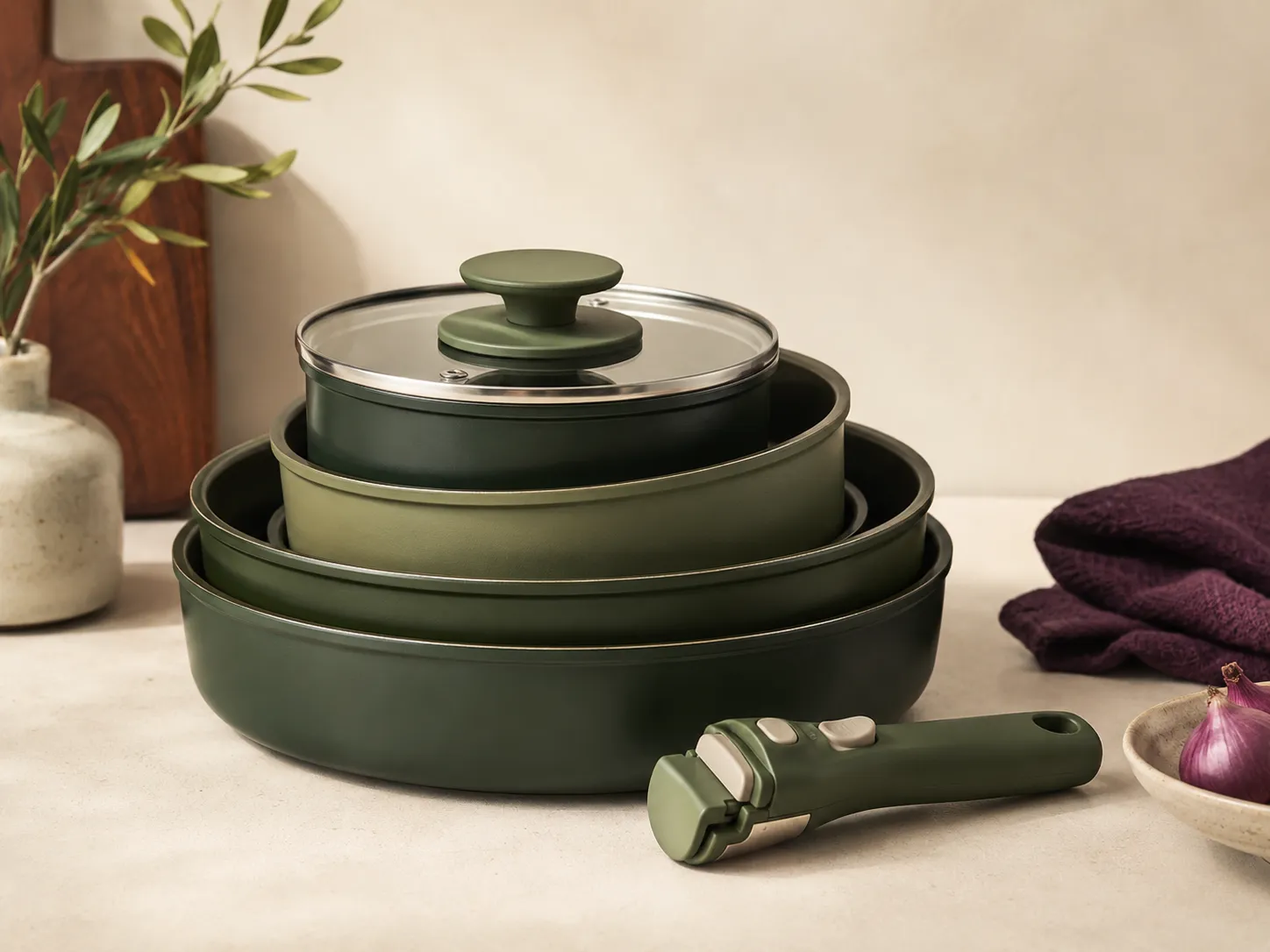
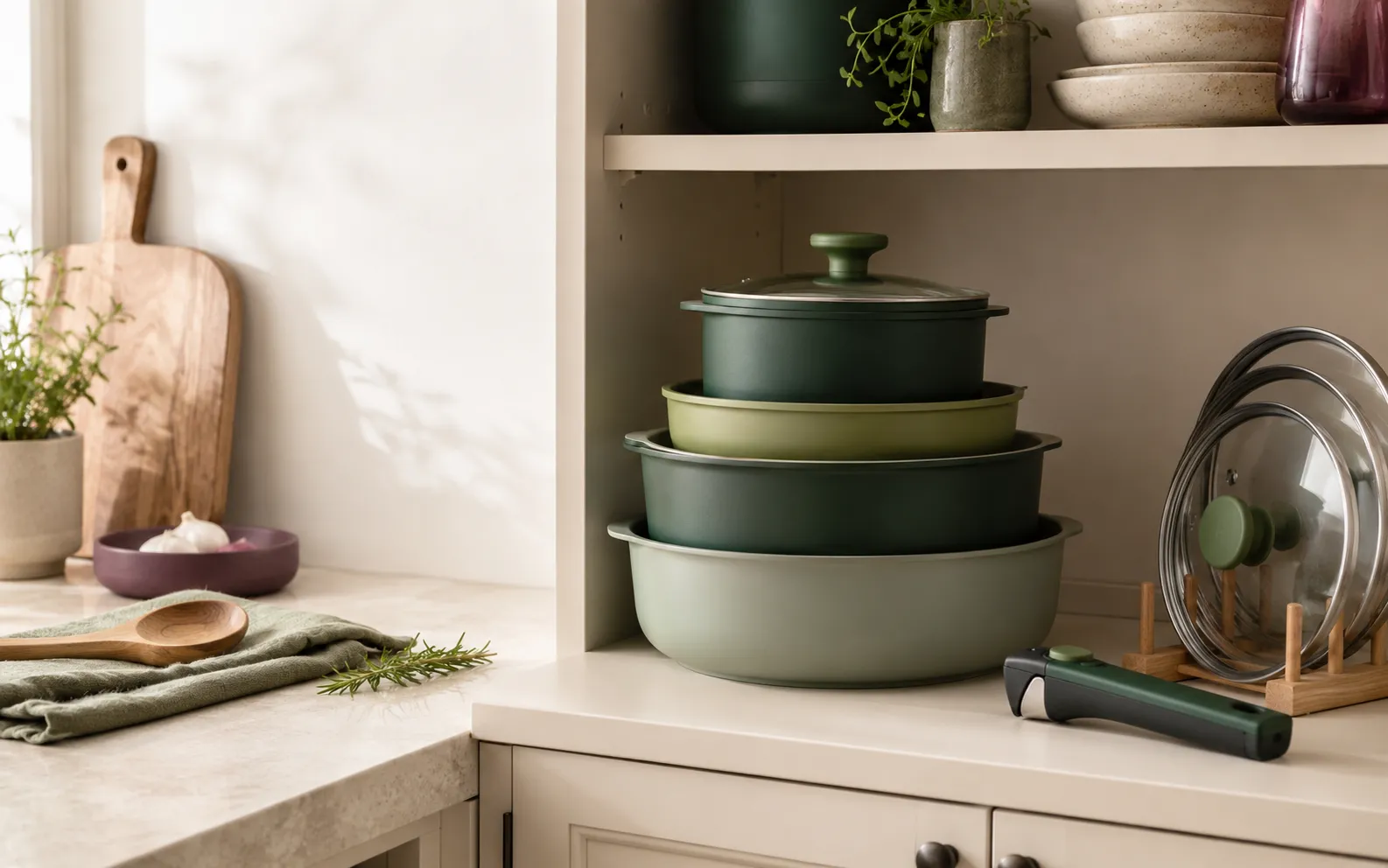
Without long fixed handles, pans may nest more closely. That can make a real difference in narrow cabinets, RV drawers, or shelves where standard skillets waste space sideways.
But the handle is only part of the story. If the pots are bulky, the lids are awkward, or the accessories do not have a home, the set may still feel cluttered.
Before choosing removable-handle cookware, check how many handles are included, which pieces use them, whether lids fit with the handle attached, and whether the set is compatible with your cooktop.
Accessories can help or create clutter
A good lid can make a saucepan more useful. Pan protectors can be worth having if you stack coated cookware. A steamer insert may be useful if you actually steam vegetables or dumplings.
The problem is clutter disguised as value. Utensils included in a cookware set may be helpful if you are starting from nothing, but duplicates become storage pressure fast.
For a small kitchen, ask one plain question about every accessory: would you store this separately if it did not come in the set? If the answer is no, do not let it influence the purchase too much.
What to check before buying
Start with the largest piece. If the stockpot or saute pan will not fit your cabinet, the rest of the set does not matter much.
Next, look at handles and lids. Fixed handles take more horizontal space. Removable handles may store better, but only if the handle count and attachment system make sense for how you cook.
Also confirm cooktop compatibility, cookware bodies included, pan sizes, dishwasher information, oven details, care instructions, and whether accessories are counted in the total piece count.
When a smaller set is better
A smaller set is often the better choice when you cook simple meals, live alone or with one other person, or have very limited cabinet space.
It can also be smarter when you already own one or two good pans. If you have a stockpot you like, buying a large set with another stockpot may not make sense.
For tight kitchens, a focused set might include one everyday skillet, one saucepan, one larger pot, one deeper pan, and lids that match the pieces you use most.
Brand examples from BrandCookware.shop
BrandCookware.shop covers GreenLife, CAROTE, and Astercook cookware pages that may be useful starting points for small-kitchen shoppers.
CAROTE and Astercook removable-handle cookware sets may be relevant if storage and nesting are your main concerns. GreenLife cookware sets may fit shoppers looking across broader coated cookware styles.
These are not blanket recommendations. Check the current listing for exact model details, included cookware bodies, handle setup, lid count, compatibility, care guidance, and oven or dishwasher information.
Bottom line
Small kitchens reward practical decisions. The right cookware set may not look huge in the product title or have the longest accessory list.
It may simply give you the pans you use, lids you can store, and a shape that fits your cabinet without turning every dinner into a rearranging project.
Start with storage. Count cookware bodies. Be suspicious of inflated piece counts. Then choose the set that fits your stove, meals, and actual space.
Small-kitchen cookware checks
- Measure the cabinet, drawer, shelf, or RV storage bay before shopping.
- Count cookware bodies separately from lids and accessories.
- Check whether fixed handles, removable handles, or lid knobs affect storage.
- Confirm cooktop compatibility, especially for induction.
- Avoid duplicate pan sizes unless you truly use both.
- Make a plan for lids, pan protectors, and extra handles.
Keep comparing
FAQ
Is a larger cookware set always worse for a small kitchen?
Not always. A larger set can work if every piece has a job and you have a real place to store it. The problem starts when extra lids, utensils, and duplicate pans take over the cabinet.
Are removable-handle cookware sets worth considering for apartments?
They can be, especially when fixed handles are the main storage problem. Still, check how many handles come with the set and how the lids store.
What is the most useful pan in a small kitchen?
For many people, it is an everyday skillet or frying pan. A saucepan is usually close behind. The right answer depends on what you cook most.
Should I avoid stockpots if my kitchen is small?
Not necessarily. A stockpot is useful for pasta, soup, and larger meals. Just be honest about size and storage.
Do pan protectors matter for stackable cookware?
They can matter if the cookware has a coated surface and the pieces will be nested together. Check the care instructions for the specific set.